



Programmatic SEO is a new way to help websites get more visitors from Google by creating many pages automatically. Instead of writing each page yourself, this method uses a smart system to make hundreds or even thousands of pages that Google likes.
Normally, trying to rank for popular keywords can take a long time and a lot of work because you have to write and improve each page one by one. Programmatic SEO makes this easier by using templates and data to build lots of pages quickly.
You’ve probably noticed big websites like Zapier, G2, or Indeed show lots of search results for very specific questions, like “best CRM for real estate” or “entry-level remote jobs in New York.” These sites use programmatic SEO to create pages for many different search terms without writing each page from scratch.
And it really works! Studies from 2025 show that websites using programmatic SEO have increased their visitors by 3 to 5 times in just a few months. This strategy focuses on small, specific long tail keywords that many websites do not target.
In this guide, you will learn step-by-step how to use programmatic SEO with simple tools and examples. This will help you grow your website traffic faster and smarter without needing to be a tech expert.
What Is Programmatic SEO?
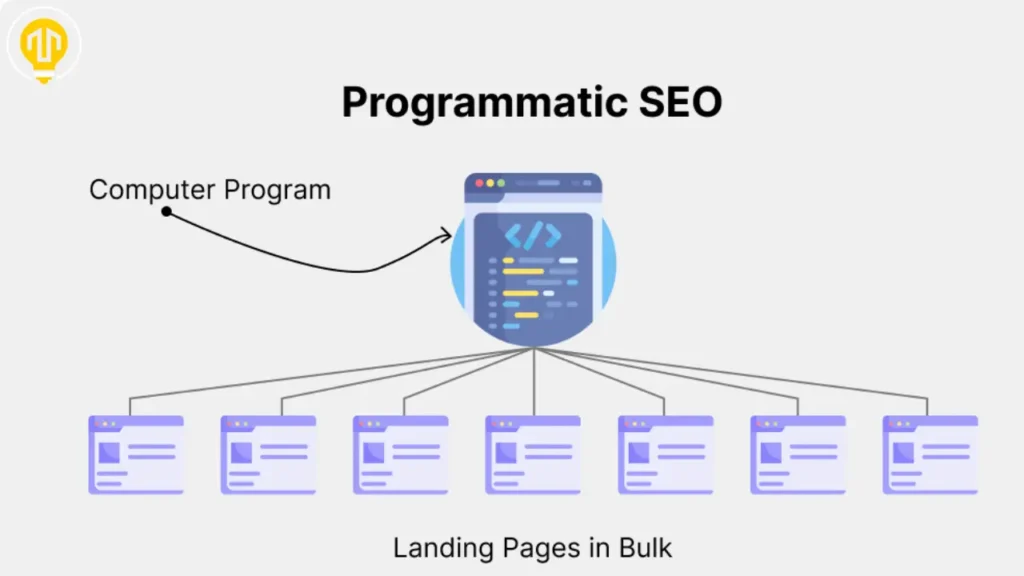
Programmatic SEO is a smart way of creating many web pages automatically instead of making each one by hand. This is done by combining a basic page template with data about your business—like city names, product info, or job types—and letting computers do the rest.
How Does It Work?
Imagine you own a store that sells many products or you run a website with lots of different cities or services. Instead of writing a new page for each one, you make one template and feed it with data—like “New York,” “red shoes,” or “digital marketing jobs.” The computer then automatically creates a separate webpage for each item, with all the details filled in, so each page is unique and useful.
Is It Cheap and Fast?
Yes! Instead of spending months writing hundreds of pages, you can generate all of them quickly with machines. This saves time and money, especially if you want your website to appear in Google for many different searches.
Does It Just Create Poor Quality Content?
No, when done correctly, each page offers real value. The goal is to make pages that are helpful and relevant so they rank well on Google and give visitors what they are searching for—their questions answered in the best way.
Why Are More Websites Using It?
Big websites like job boards or online stores use this method. For example, a site like Indeed creates thousands of pages for jobs in different cities and roles automatically. This way, they can rank high in Google for many specific searches, bringing in more visitors.
Main Things to Remember
Programmatic SEO uses smart tools to make many helpful web pages automatically. It’s perfect for websites with lots of similar content like listings, stores, or service pages.
When used wisely, it can help you grow your site faster and reach many more people without spending lots of extra effort or money.
How Programmatic SEO Works Behind the Scenes
Programmatic SEO works by combining a pre-designed content template with a database of keywords or data, then using automation tools to publish large numbers of SEO-friendly pages efficiently.
The Workflow in Detail
A well-structured programmatic SEO process usually follows these steps:
1. Keyword and Topic Discovery
Begin with long-tail keyword research. Identify specific, low-competition search terms that users are actively searching for. These could include combinations like “best running shoes for flat feet” or “plumbers in downtown Toronto.”
2. Build a Content Template
Create a flexible content layout with placeholders where data will be inserted. This ensures each page follows a consistent structure while still serving unique content.
3. Organize the Data
Prepare a spreadsheet or database containing variations of the keywords or categories you want to target—such as cities, services, job types, or product features.
4. Connect Data with Template
Use tools like Webflow CMS, Airtable, WordPress plugins, or Google Sheets to dynamically populate your content templates with the structured data.
5. Publish and Interlink
Once connected, you can generate hundreds or thousands of pages with a single automated workflow. Proper internal linking ensures crawlability and improves user navigation.
Supporting Tools
- Google Sheets or Airtable for data organization
- Webflow CMS or WordPress for page templates
- Automation platforms like Zapier or Make for integrations
- Use keyword research tools like Ahrefs or Ubersuggest to uncover valuable search terms.
Main Things to Remember
- Programmatic SEO is a systematic approach that integrates data, templates, and automation to streamline content creation.
- It enables long-tail keyword automation at scale.
- Strong internal linking and well-designed templates are critical components of a successful strategy.
Why Programmatic SEO Matters: Key Benefits You Should Know
Programmatic SEO offers benefits such as faster content production, scalable traffic growth, better coverage of long-tail keywords, and reduced manual workload for large websites.
Why It’s a Smart Investment
Programmatic SEO is not just a shortcut—it’s a strategic approach to content growth. Here’s why more businesses are turning to it:
1. Scalable SEO Strategy
You can build thousands of pages from a single framework, making it possible to scale your content marketing efforts rapidly.
2. Dominates Long-Tail Keywords
These specific queries often have less competition and higher conversion intent. Programmatic SEO allows you to reach these keywords with precision and efficiency.
3. Reduces Time and Cost
Once the system is built, content creation becomes largely automated, saving teams both time and money over the long term.
4. Boosts Organic Visibility
With more indexed pages targeting focused search intents, your site has more opportunities to rank across different search queries.
Use Cases in the Real World
- Zapier automatically builds tailored pages for every app integration scenario, boosting visibility across search results.
- G2 uses programmatic pages to cover every software tool and user review category.
- Local directory websites use it to target location + service combinations.
Ideal for:
- SaaS companies needing pages for features or integrations
- Affiliate websites targeting product variations
- Local businesses expanding city-wise
- E-commerce stores with multiple product types or categories
Main Things to Remember
Programmatic SEO is a smart system that uses data, templates, and automation to build many helpful pages quickly.
It’s perfect for websites that need lots of similar pages, like job boards, stores, or service directories.
Good templates and strong internal linking are very important for success.
Programmatic SEO vs Traditional SEO: What’s the Difference?
Traditional SEO focuses on creating individual, manually written pages, while programmatic SEO uses templates and data to create many similar pages automatically and efficiently.
Core Differences
Understanding how these two approaches differ helps you decide when and how to apply them.
| Feature | Traditional SEO | Programmatic SEO |
| Content Creation | Manual, one-by-one | Automated, data-driven |
| Best Suited For | Blog posts, landing pages | Service/location/product variations |
| Time Required | High | Moderate to low (after setup) |
| Keyword Targeting | High-volume, broad terms | Long-tail, specific queries |
| Scalability | Limited | Highly scalable |
When Should You Use Each?
Use Traditional SEO When:
- Writing in-depth blog content or editorial pieces
- Building cornerstone content for authority
- Targeting short-tail or medium-tail keywords
Use Programmatic SEO When:
- You have repeatable content types (e.g., locations, services, product specs)
- You want to expand coverage on long-tail keyword variations
- It’s essential to develop an SEO strategy that can scale effectively and efficiently.
Can Both Work Together?
Yes. In fact, the best-performing sites blend the two. Use traditional SEO to create high-value content pillars and programmatic SEO to cover supporting long-tail queries. This approach builds topical authority while enhancing the structure of your internal links.
Main Things to Remember
- Traditional and programmatic SEO serve different purposes but complement each other.
- Programmatic SEO is more efficient for scale, while traditional SEO builds depth and authority.
- Combining both leads to better overall search performance.
Real-World Examples of Programmatic SEO in Action
What does Programmatic SEO look like in the real world?
Programmatic SEO is already powering some of the most successful websites on the internet. It works by using templates and data to generate thousands of pages targeting long-tail keywords at scale. These aren’t just theory-based models—they’re working strategies used by major digital brands.
Real Brands Using Programmatic SEO
Let’s break down how leading companies are using programmatic SEO today:
- Zapier: Zapier creates automated pages for nearly every app combination imaginable—like “Connect Gmail to Google Sheets”—driven by automation and intent-specific keywords.
- Nomad List: This travel site builds location-based pages for remote workers. Each page, like “Best Cities for Remote Work in Asia,” is created dynamically using structured data.
- Tripadvisor: With pages for every city, activity, and restaurant, Tripadvisor capitalizes on local intent by scaling pages built with consistent templates and user-generated content.
- Airbnb: Airbnb ranks for endless combinations like “Best Airbnbs in New York for Families.” These location + niche pages are generated programmatically.
- Eater: Their site features dynamic location-based guides, such as “Top Brunch Spots in Brooklyn” or “Where to Eat Near Times Square.”
- Yelp: Uses programmatic pages to rank for “Top dentists in [City]” or “Best restaurants near [Landmark].”
- Userpilot: They’ve built automated SEO pages around product and feature comparisons like “Userpilot vs Appcues.”
Why These Examples Matter
These companies are not just ranking—they’re converting. Their programmatic pages are optimized for long-tail keywords, solve user intent, and deliver value. The takeaway? You don’t need to reinvent the wheel. Instead, model what’s working at scale and adapt it to your niche.
When to Use Programmatic SEO (And When Not To)
Programmatic SEO is best suited for businesses that need to create hundreds or thousands of pages targeting long-tail keywords at scale. It works well for industries like SaaS, marketplaces, directories, and review platforms. However, it’s not ideal for brands that rely on high-authority thought leadership content or creative storytelling.
Where It Works Best
Programmatic SEO is highly effective in industries where:
- You deal with structured data
- Your users are searching variations of the same thing
- You want to rank for long-tail keywords automatically
Common industries using this approach:
- SaaS tools (like Userpilot, which builds guides for feature adoption)
- Marketplaces (such as Nomad List and Airbnb)
- Job boards or real estate listings
- Niche-specific directories based on location or services—examples include Tripadvisor and Yelp.
These platforms use scalable templates to generate pages for every city, job title, or product variation, capturing thousands of search intents.
When It Doesn’t Work
Programmatic SEO is not a good fit when:
- Your content relies heavily on personal stories, opinions, or creative tone
- You don’t have structured data or repeatable templates
- Your topic is niche and doesn’t have enough search variations
- You lack the time or tools to manage automation
In such cases, traditional SEO with handcrafted content is better.
What You Should Know
- Don’t force programmatic SEO into a business model where scale doesn’t naturally exist
- It’s not “automated blogging”—it’s smart automation based on structure and intent
- Leverage it as a supplement to high-quality editorial content, not a substitute.
How to Build a Programmatic SEO Site (Even Without Code)
You can build a programmatic SEO site without knowing how to code by using no-code tools like Webflow, Airtable, and Google Sheets. These tools let you create, manage, and publish hundreds of SEO-friendly pages automatically using templates and structured data.
Step-by-Step Framework
Step 1: Prepare Your Data
- Organize long-tail keyword variations efficiently using tools like Google Sheets or Airtable.
- Include columns like location, product type, category, etc.
Step 2: Build Page Templates
- Use Webflow CMS or WordPress to design dynamic templates
- Insert placeholder variables (e.g., [city], [product], [price]) for automation
Step 3: Automate Page Creation
- Connect your sheet to Webflow using Zapier
- Pages are auto-generated based on your template and sheet data
Step 4: Add Internal Links
- Use tools or simple rules to build internal links between related pages
- For example, link “Best Coworking Spaces in Lisbon” to “Best Cities for Digital Nomads”
What You Should Know
- No-code doesn’t mean no strategy — your content structure still matters
- Use logical categories and keyword clusters
- Ensure your templates are SEO-friendly by optimizing headings, meta tags, and structured data.
Real-world Example
- Zapier uses this system for its integration pages
- Nomad List has dynamic city pages built from a central data sheet
- Eater builds city-specific food lists based on repeating data points
Tools You Need for Successful Programmatic SEO
To execute a successful programmatic SEO strategy, you’ll need tools for data organization (like Airtable), content generation (like ChatGPT or Frase), publishing (like Webflow or WordPress), and tracking (like Ahrefs and Google Search Console).
Tool Stack Breakdown
1. Content Generation Tools
- ChatGPT or Jasper: for generating product/service descriptions
- Frase: helps optimize content around real-time SERP data
2. Data Organization
- Airtable: spreadsheet + database hybrid
- Google Sheets: perfect for initial keyword mapping
3. Website Builders / CMS
- Webflow CMS: allows dynamic content pages
- WordPress works seamlessly with plugins such as WP All Import and Advanced Custom Fields for enhanced functionality.
4. Automation
- Zapier links your spreadsheet to your CMS, enabling automated content publishing.
- Make (Integromat): alternative for multi-step automation
5. SEO Tracking
- Google Search Console: track indexing status and measure page performance effectively.
- Ahrefs or Semrush: to track backlinks, keyword positions, and page-level SEO
What You Should Know
- You don’t need every tool; choose based on your comfort and workflow
- Many tools have free plans or trials
- The real power comes when these tools are combined into a scalable workflow
Real-world Lessons
- Semrush has used scalable templates for tools and blog hubs
- Userpilot uses data and automation to build onboarding pages at scale
- Even Tripadvisor automates city and attraction pages based on database input
Common Mistakes to Avoid in Programmatic SEO
The most common mistakes in programmatic SEO include publishing thin or duplicate content, neglecting internal linking, ignoring user experience, and causing keyword cannibalization across similar pages.
Why Most Programmatic SEO Projects Fail
While programmatic SEO sounds like a scalable and smart way to grow organic traffic, many websites fail to see results due to some basic but damaging mistakes. These are the exact issues that prevent search engines from ranking your pages and users from engaging with them.
Now, let’s examine some of the most frequent mistakes to watch out for.
1. Publishing Thin or Duplicate Content
When you’re creating thousands of pages using templates, it’s easy to fall into the trap of duplicate content. But if your pages only change one or two words (like location or price) and everything else is identical, Google will consider them low-quality.
Add unique descriptions, internal references, or dynamic widgets to make pages stand out.
2. Weak Internal Linking
Internal linking is how your content connects and passes value. If your programmatic site lacks a strong internal linking structure, it will fail to build topical clusters and distribute authority across pages.
Use Cases:
- Nomad List links cities to cost, weather, and safety pages.
- Tripadvisor brings together attractions, dining options, and user reviews for each city it covers.
3. Poor UX (User Experience)
An efficient, mobile-optimized, and well-organized site structure is crucial for success. Users don’t care how pages were built—they just want to find what they’re looking for fast.
4. Keyword Cannibalization
If multiple pages target identical or similar keywords, they end up competing in search rankings—diluting your site’s authority on the subject.
How to Avoid These Mistakes:
- Audit your pages using tools like Ahrefs Site Audit
- Use canonical tags for similar URLs
- Build internal links to support page relationships
- Make your templates human-first, not just machine-generated
Best Practices and Pro Tips for Long-Term Success
To ensure long-term success with programmatic SEO, use dynamic content, humanize templates, maintain EEAT standards, and focus on topical depth rather than page quantity.
Build for the Long Haul, Not Just Rankings
Programmatic SEO is powerful — but only if you treat it as a long-term strategy, not a short-term traffic hack. The goal isn’t to publish thousands of pages quickly. The goal is to provide structured, useful, and scalable content that solves real problems.
1. Use Dynamic and Useful Content
Pages should feel like they were made just for the user visiting them. Add widgets, updated stats, unique data filters, or community input.
Real Examples:
- Zapier uses dynamic automation tools and filterable app databases.
- Yelp localizes pages with reviews, top lists, and real-time ratings.
- Eater uses city-based restaurant pages with curated recommendations.
2. Humanize Your Templates
Template-generated content shouldn’t sound robotic. Add real-world examples, locally relevant details, or user-generated content. Even a small manual touch, like adding editor picks or tips, can increase dwell time.
3. Build Topical Authority (Not Just Quantity)
Programmatic pages should be organized within a well-defined topical structure. If you’re building a SaaS SEO hub, make sure to interlink with blog content, FAQs, and case studies.
EEAT (Expertise, Experience, Authoritativeness, Trust):
- Show who’s behind the content
- Add expert quotes or sources
- Maintain consistent brand tone and updated info
4. Regularly Audit and Refresh
SEO isn’t set-it-and-forget-it. Set monthly check-ins to:
- Review traffic drop-offs
- Fix outdated content
- Add new keyword layers or filter pages
Success in programmatic SEO doesn’t come from how many pages you create, but how useful, structured, and meaningful those pages are to both search engines and humans.
Key Benefits of Programmatic SEO for Scalable Growth
Programmatic SEO helps you scale content creation by automating the process of building pages for thousands of keyword variations, improving search visibility, increasing organic traffic, and saving time and resources while targeting long-tail keywords effectively.
If you’re working on a large-scale website like a job board, directory, SaaS product, or marketplace Programmatic SEO can save you hours of manual effort while giving you powerful growth.
Below are the key benefits, outlined for clarity and impact.
1. Scales Easily Across Hundreds (or Thousands) of Pages
Instead of writing content for every page manually, you create smart templates and connect them to structured data. This allows you to build thousands of SEO-optimized pages at once — perfect for sites with many locations, products, or services.
2. Better User Experience
Each page can deliver relevant, local, or topic-specific information, helping users find exactly what they’re looking for faster. Visitors are more likely to stay and engage when they arrive on a page that offers clear, well-organized, and valuable content.
3. Powered by Real Data
Programmatic SEO uses actual data (from Airtable, Google Sheets, APIs, etc.) to shape content. This means you’re not guessing what to write — you’re creating pages based on what users are searching for and what they need.
4. Saves Time and Resources
You don’t need to hire 10 writers to scale your content. With the right setup, a small team — or even a solo founder — can generate and manage thousands of pages efficiently using no-code tools like Webflow, Sheets, and Zapier.
5. Stronger Search Visibility
Because you’re targeting long-tail keywords at scale, you can dominate niche search queries. These pages help you cover the full spectrum of what your potential audience might be searching — and often with lower competition.
6. Consistent SEO Performance
Templates ensure your pages follow a consistent structure, making it easier to apply technical SEO best practices (like internal linking, title tags, and meta descriptions) across your entire site.
7. Lower Costs, Higher ROI
Once your system is set up, the cost per page is minimal. Compared to traditional content marketing where each page needs individual effort, programmatic SEO reduces overhead — and grows your organic traffic affordably.
8. Smart Keyword Expansion
You can discover and use keywords that scale — like “best [product] in [city]” or “how to apply for [service] in [location]”. This strategy uncovers hundreds of long-tail keywords you can target with data-driven templates.
9. Adapts Easily to SEO Trends
If search engine algorithms change or Google updates its ranking factors, it’s easier to update a template or data set — instead of editing thousands of pages one by one.
10. Structured Page Creation
From building city pages to category or comparison pages, programmatic SEO helps you publish meaningful content, fast. These pages often drive traffic, build authority, and bring in leads.
11. More Leads, Less Guesswork
By targeting highly specific keywords, users who land on your programmatic pages are often closer to taking action. Whether it’s a booking, form submission, or sale — your conversion rate improves.
12. Smarter Use of Your Team’s Efforts
Writers, SEOs, and developers can work together more efficiently. Instead of repeating tasks, they can focus on building scalable systems that deliver better results over time.
Programmatic SEO isn’t just a shortcut — it’s a smarter, data-driven way to win in search. When done right, it delivers long-term growth, clearer ROI, and a strong presence across search engines.
Would you like this turned into a nicely formatted blog section with subheadings and bullet points?
How to Build an Effective Programmatic SEO Strategy — Step by Step
A programmatic SEO strategy is a structured approach to scaling SEO by creating thousands of landing pages that target long-tail keywords using templates, automation tools, and structured data. It is most useful for websites like job boards, directories, SaaS platforms, and travel aggregators. The key is to maintain quality and structure while automating volume.
1. Understand Your Audience and Intent
Before creating anything, research what people are searching for and how they search it. Focus on long-tail keywords — they have low competition and high intent.
- Use tools like Ahrefs, Semrush, and Google Search Console to explore search patterns.
- Understand search intent: Are users looking to buy, compare, or learn?
Example: Tripadvisor builds pages like “best restaurants in Rome” or “top hotels near Eiffel Tower” to target long-tail queries at scale.
2. Build a Clean Keyword Map
Once you know the types of searches you’re targeting:
- Group keywords by intent and topic.
- Find patterns in search terms (e.g., “best [product] in [city]” or “cheap [service] near me”).
- Map these to templated page structures.
Example: Nomad List maps “Cost of Living in [City]” across hundreds of destinations.
3. Create Structured Templates
Your pages will follow a similar format, so:
- Design reusable templates with placeholders (e.g., [City], [Product], [Service]).
- Add SEO tags, headings, meta descriptions, and schema markup.
Use CMS tools like Webflow, WordPress (with plugins), or a custom stack with Airtable + Sheets for structured data.
4. Focus on High-Quality Content
Even though it’s automated, every page must deliver real value:
- Avoid thin or duplicated content.
- Add unique data, reviews, maps, images, or comparisons.
- Use dynamic content where applicable.
Example: Yelp and Eater use user-generated content and real data to add uniqueness to each page.
5. Connect the Pages Through Internal Links
A good internal linking structure:
- Helps Google understand page relationships.
- Improves crawling and distributes authority.
- Boosts user experience.
Use automation to generate links based on category, location, or product attributes.
6. Monitor Performance and Refine
After publishing:
- Track pages using Google Search Console and Ahrefs.
- Monitor indexation, CTR, bounce rates, and page value.
- Improve or delete underperforming pages to maintain quality.
Key Tools You May Need
- Keyword & Research: Semrush, Ahrefs
- Data Management: Airtable, Google Sheets
- Content & Publishing: Webflow, WordPress, Frase
- Automation & Linking: Zapier, InLinks
Programmatic SEO isn’t just about scaling—it’s about scaling smartly. If you focus on user experience, relevance, and quality, you can build a traffic engine that continues to grow. It’s how companies like Zapier, Userpilot, and Tripadvisor have scaled millions of pages that still feel personal and useful.
Want to build this for your business? Start with one topic cluster and test it before going big.
Is Programmatic SEO Still Effective in 2025?
Absolutely — programmatic SEO remains a powerful and scalable strategy in 2025, provided it’s executed with precision and quality. As Google continues to prioritize user experience, relevance, and authority, programmatic SEO has evolved to meet higher standards. It’s no longer about generating thousands of pages for the sake of volume — it’s about creating structured, intent-driven, and useful content at scale.
Why Programmatic SEO Still Works in 2025
1. Scalability That Meets Market Demands
With the growing need for expansive digital visibility, businesses can’t rely solely on manual content creation. Programmatic SEO enables the generation of hundreds or thousands of targeted pages based on structured data and templates — making it ideal for covering long-tail, niche, and location-based queries.
2. Alignment with Google’s Evolving Guidelines
Google’s core updates, including the Helpful Content Update, target low-quality and spammy content — not well-structured, data-rich programmatic pages. If your content delivers value, follows EEAT (Experience, Expertise, Authoritativeness, and Trust), and genuinely solves search intent, it will continue to perform.
3. Better Coverage of Long-Tail and Intent-Based Keywords
In 2025, search behavior is more nuanced. Programmatic SEO allows you to capture micro-intents — those lesser-known but highly targeted keyword combinations — that traditional content strategies often overlook.
4. Integration with Automation and UX Enhancements
Modern tools (like Webflow, Airtable, WordPress, and AI-assisted editors) make it easier to automate structured page creation while still maintaining high UX and readability. This blend of automation with personalization and user-focused design is the backbone of effective programmatic SEO today.
5. A Strategic Edge in Competitive Niches
Industries such as SaaS, e-commerce, travel, healthcare, and local services are leveraging programmatic SEO to dominate SERPs by building out location-specific, feature-specific, or use-case-specific content hubs. When paired with proper internal linking and topical authority, the strategy drives measurable growth.
Programmatic SEO is not only relevant in 2025 — it’s essential for brands seeking scalable growth. The key lies in moving beyond automation for volume’s sake and focusing on data-driven, humanized, and search-intent-aligned content. Businesses that embrace this approach will continue to see strong visibility, better engagement, and improved ROI from search.
Building Scalable SEO That Actually Works
Programmatic SEO is not just a traffic-generation hack — it’s a long-term strategy built on data, structure, and user intent. When done right, it allows you to scale your website into thousands of useful, searchable, and well-optimized pages without sacrificing quality.
But success doesn’t come from automation alone. It depends on how well you understand your audience, how strategically you map keywords, how uniquely you design your templates, and how consistently you add real value to every page. Brands like Zapier, Tripadvisor, Nomad List, and Userpilot have mastered this balance — and it’s what makes their programmatic content both scalable and trustworthy.
If you’re ready to create a sustainable SEO engine that grows with time, programmatic SEO can be your competitive advantage — but only if you prioritize quality over shortcuts.
For businesses looking to implement this smartly and effectively, Local City Solutions offers tailored digital strategies to help you launch and scale programmatic SEO campaigns with real, measurable impact. Let’s build smarter SEO together.
